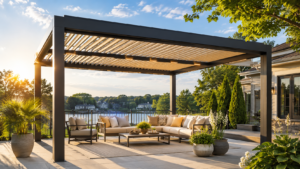
What are outdoor pergolas in New Jersey?
Outdoor pergolas in New Jersey are freestanding or house-attached shade structures built for a climate that swings from humid summers to freezing winters. The word pergola traces back to Latin and Italian usage for an arbor or trellis. New Jersey spans roughly 39 to 41 degrees north latitude, so one structure handles a steep June sun and a shallow December sun in the same year. The New Jersey Uniform Construction Code, which adopts the International Residential Code with state amendments, sets how these structures are anchored and framed.
Pergola construction splits into three roof families: open rafters, retractable fabric, and rotating aluminum louvers. Open-rafter frames filter light and let rain pass through. Retractable systems pull a fabric membrane along a track, which converts the roof from open to covered without any structural change. Louvered roofs rotate extruded aluminum blades, so one structure delivers dappled light at noon and a sealed cover during a storm.
How does the New Jersey climate shape pergola design?
New Jersey falls into United States Department of Agriculture plant hardiness zones 6a through 7b, a band that pairs hot humid summers with sub-freezing winters. Ground snow load across the state generally runs between 20 and 30 psf (pounds per square foot), with the highest values in the northwestern counties. Design wind speed rises toward the Atlantic coast, so Cape May and Ocean County projects face stronger uplift than Morris County projects. These two loads decide post spacing, beam depth, and anchor type before any style question is settled.
Frost heave, the lifting of soil as trapped water freezes, sets the foundation depth. Footings under a permanent pergola extend below the frost line, the depth to which ground moisture freezes, which runs about 30 to 36 inches across New Jersey. Shallow footings lift and tilt after a few freeze-thaw cycles, and a tilted post binds a louver mechanism. Snow and wind loads are the reason outdoor pergolas in New Jersey carry heavier framing than the same product sold in a snow-free market.
How much shade does a pergola actually produce?
Shade output depends on the sun’s altitude angle, not on the size of the roof alone. At about 41 degrees north latitude, the midday sun sits roughly 72 degrees above the horizon in late June and near 26 degrees in late December. A 10-foot-tall pergola therefore throws a shadow around 3 feet long at the June angle and past 20 feet at the December angle.
Roof type sets the coverage ceiling. Open rafters at conventional spacing block part of the overhead sun and none of the low afternoon sun from the west. Rotating louvers move between full cover and open sky on demand, so one roof serves a bright spring morning and a hot August afternoon.
Vertical exposure decides comfort after 4 p.m. West-facing patios take low-angle sun straight under the roof line, and drop screens or planted screening handle that vertical plane. A pergola judged only on its roof will underperform on a July evening.
Which pergola roof types work in New Jersey and New York?
Pergola roof types split into three families across the New Jersey and New York region. Each family answers a different question about rain, snow, and light control.
| Roof type | Rain protection | Shade control | Winter position |
| Open rafter frame | None | Fixed and partial | Left in place |
| Retractable fabric | Light rain only | Open or closed | Membrane retracted |
| Rotating aluminum louver | Full when closed | Adjustable through the blade arc | Set by the snow rating |
Open-rafter frames
Open-rafter frames are the traditional pergola: posts, beams, and evenly spaced rafters with nothing between them. Rain passes straight through, so the space under the frame stays a fair-weather space. Gardeners use it as a support for wisteria and climbing hydrangea, and it carries the lowest cost of the three.
Retractable fabric roofs
Retractable fabric roofs run a coated membrane along a motorized track between the beams. The membrane retracts into a cassette, a protective housing at the beam, which removes the snow-load question for winter. Fabric carries a service life measured in years rather than decades, so replacement belongs in the ownership cost.
Rotating aluminum louver roofs
Rotating aluminum louver roofs use extruded blades turned by a motor or a manual crank. Closed blades form a water-shedding surface that channels rain into hidden gutters inside the beams and posts. This bioclimatic category, meaning a roof that adapts to live weather, carries the highest cost and the widest control range.
Regional fabricators usually carry more than one of these systems in a single catalog. Buyers comparing outdoor pergolas in New Jersey find retractable fabric systems and aluminum louver systems listed side by side. Vision Art Aluminium, which keeps a showroom on Valley Road in Montclair, lists both formats and covers New Jersey and New York. The choice turns on whether the owner wants a fabric membrane or a solid blade overhead.
Why does aluminum outperform wood and vinyl outdoors?
Aluminum resists the three failure modes that end the life of an outdoor structure: rot, insect attack, and moisture-driven warping. Aluminum weighs about 2.7 grams per cubic centimeter against roughly 7.85 for steel, so long spans stay light enough to ride on a motorized track. Powder coating, a dry finish baked onto the metal, gives a color layer that skips annual repainting. Structural aluminum in architectural systems comes from the 6000-series alloy family, which combines easy extrusion with corrosion resistance.
Wood pergolas carry a recurring cycle of cleaning, sealing, and stain renewal. Untreated cedar weathers to gray, and pressure-treated pine checks and splits along the grain. Vinyl and composite frames avoid the finishing work but limit clear spans, because the material softens in summer heat.
Thermal movement is the trade-off aluminum brings. Aluminum expands about 23 micrometers per meter for each degree Celsius, so a 20-foot beam moves several millimeters between a January night and a July afternoon. Engineered systems absorb that movement in slip joints, and a frame without them binds its own louver mechanism.
What does season extension mean in practice?
Season extension means turning a summer-only patio into a space that works from early spring into late fall. Uncovered outdoor living in New Jersey concentrates into June, July, and August. A controllable roof adds April, May, September, and October by handling rain, wind, and low sun. Restaurants apply the same logic to keep exterior seating in service outside the peak months.
Four add-ons carry most of the extension work:
- Infrared heaters on the beams, which warm surfaces rather than air and hold their effect in moving air
- Retractable side screens that block wind and low western sun
- Integrated LED (light-emitting diode) lighting inside the blades or beams, which extends usable hours after sunset
- Rain sensors that close a louvered roof automatically while the owner is away
Water management separates a real season-extension system from a decorative one. Closed louvers collect rain in a channel at the blade edge and route it through the beam into a hollow post. Systems without internal drainage push every gallon to one line, which then freezes on the walking surface in December.
Which permits and structural checks apply in New Jersey?
Permit requirements in New Jersey run on two separate tracks: construction code and municipal zoning. The construction code exempts certain small detached accessory structures from a building permit, with 200 square feet of floor area as the common threshold. Municipal offices check setback, the required distance from a property line, along with lot coverage and structure height.
Attachment to the house changes the review. A pergola bolted to the dwelling becomes part of the building envelope, which brings flashing, the ledger board at the wall, and the load path into scope. A louvered roof rated to hold snow states a load figure, and an unrated roof opens before a storm arrives. Electrical permits apply separately once motors, heaters, or lighting circuits enter the design.
What maintenance does an aluminum pergola need?
Maintenance on an aluminum pergola is cleaning work rather than repair work. Powder-coated surfaces need washing with mild detergent, usually twice a year in the mid-Atlantic pollen and leaf cycle. Most outdoor pergolas in New Jersey sit under oak and maple canopy, so October leaf fall and April pollen both reach the roof channels. Blocked channels are the most common cause of overflow at the beam edge.
Moving parts need a short annual check:
- Clear the blade channels, beam gutters, and post outlets before winter
- Inspect the gearbox and drive arms for play or corrosion at the fasteners
- Confirm the manual override works while power is off
- Check the fabric membrane for seam wear on retractable systems
Which pergola fits which New Jersey property?
Pergola selection narrows to four findings from the sections above. Open-rafter frames suit gardeners and budget-led projects where rain protection is not the goal. Retractable fabric suits owners who want full cover in summer and a bare frame in winter, at a lower entry price than louvers. Rotating aluminum louvers suit year-round use, restaurant terraces, and any property where the roof has to work in rain.
Site conditions decide as much as product category. A west-facing patio needs vertical screening whatever the roof type, because a December sun at 26 degrees passes under any horizontal structure. Coastal properties in Ocean and Cape May counties weight wind uplift ahead of shade performance.
Pergola pricing, permit thresholds, and structural load requirements change by municipality and by code cycle. Verify current requirements with the local construction office and confirm product specifications with the manufacturer before ordering.
Frequently Asked Questions
Do pergolas need a permit in New Jersey?
Permit requirements depend on the municipality and on how the pergola attaches to the house. New Jersey construction code exempts some small detached accessory structures, with 200 square feet as the common threshold. Zoning review for setbacks runs on a separate track from that exemption.
Can an aluminum louver pergola hold snow?
Snow capacity depends on the system rating, not on the material. Manufacturers publish a load figure for roofs engineered to stay closed in winter. Roofs without a snow rating open instead, so snow falls through the gaps. New Jersey ground snow loads sit between 20 and 30 pounds per square foot.
How much shade does a louvered roof give?
A louvered roof gives adjustable shade from near zero to full coverage across its footprint. Blades in the closed position block direct sun and shed rain into the internal gutters. Open blades let light and air pass between them. Low western sun after 4 p.m. still reaches under the roof.
Which pergola type works for winter use?
Rotating aluminum louver systems handle winter use better than the other two types. Closed blades block rain and snow, and hidden gutters route meltwater away from the patio. Paired with infrared heaters and side screens, the covered area stays usable in shoulder months.
What is the difference between a pergola and a sunroom?
A pergola is an open-air structure with a roof plane and no permanent walls or glazing. A sunroom is an enclosed glazed room with insulated frames, sealed against weather. Pergolas extend the outdoor season, while sunrooms create interior square footage under heavier code requirements.