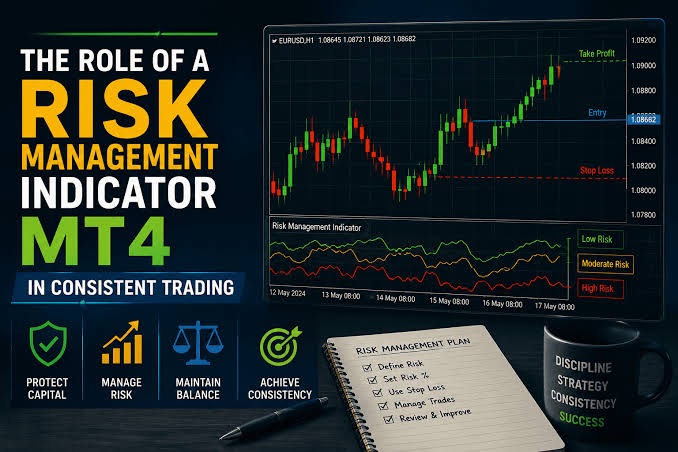
Most traders focus the bulk of their attention on entry signals—finding the right moment to buy or sell. Entry is important, but it is only one part of a complete trading decision. The exit strategy, the position size, and the maximum tolerable loss are equally critical, and yet these elements are frequently underestimated or handled inconsistently. A risk management indicator MT4 addresses this imbalance by providing a structured, automated framework for managing exposure on every trade.
This article examines the core functions of risk management indicators in MetaTrader 4, their practical application across different trading styles, and why integrating these tools is a professional standard rather than an optional extra.
Understanding the Gap Between Strategy and Execution
A trader may have a statistically sound strategy—one with a proven edge over a large sample of trades. Yet the same trader may still lose money over time. How is this possible?
The answer usually lies in execution inconsistency. Taking larger positions during periods of confidence, skipping the stop-loss on trades that “feel” certain, holding losing positions beyond the original plan—these behaviors erode the statistical edge of even the best strategies.
Risk management indicators exist precisely to close this gap. By automating the calculation and display of risk parameters, they create a consistent execution environment that is independent of the trader’s psychological state at any given moment.
Core Functions of a Risk Management Indicator in MT4
Position Size Calculator
The most fundamental function of a risk management indicator is calculating the appropriate position size for each trade. This calculation takes into account the trader’s account balance, their defined risk exposure per trade, the entry price, and the stop-loss level. The result is a specific lot size that ensures the potential loss on the trade remains within the trader’s pre-defined limit.
Visual Stop-Loss and Target Mapping
Advanced risk indicators allow traders to map their stop-loss and take-profit levels directly on the chart using draggable lines. As these lines are repositioned, the indicator updates the position size and projected outcome in real time. This visual approach makes it easier to assess the quality of a trade setup before committing capital.
Reward-to-Risk Ratio Display
Knowing the reward-to-risk ratio of a trade before entry is non-negotiable for professional traders. A risk management indicator calculates and displays this ratio instantly, allowing the trader to compare it against their required minimum. Trades that fall below the threshold are filtered out before they enter the market.
Account Exposure Overview
Some indicators go beyond single-trade risk management and provide a running total of exposure across all open positions. This feature is particularly valuable during periods of high market activity when multiple positions may be open simultaneously.
Why MT4 Is the Preferred Platform for Risk Tools
MetaTrader 4 has maintained its position as a leading trading platform for several key reasons. Its custom indicator framework—based on the MQL4 programming language—gives developers the flexibility to build sophisticated tools that integrate directly into the charting environment. This means risk indicators in MT4 are not external applications that require switching between windows; they operate within the same interface where the trader is analyzing and executing trades.
The platform’s widespread adoption also means that a large library of tested, community-developed risk indicators is readily available. Traders can find tools tailored to specific asset classes, trading styles, and risk frameworks without needing to build them from scratch.
Applying Risk Management Indicators Across Different Trading Styles
Scalp Trading
Scalp traders execute numerous trades across short timeframes, often holding positions for seconds or minutes. In this environment, speed is critical, and manual risk calculations are simply not practical. A risk indicator that calculates position size instantly and displays it on the chart allows scalp traders to act quickly without sacrificing precision.
Day Trading
Day traders typically hold positions within a single session and make several calculated decisions each day. For these traders, a risk indicator that shows the cumulative exposure across open positions is particularly useful, as it prevents over-concentration of risk within a single trading session.
Swing Trading
Swing traders hold positions over multiple days or weeks, making fewer but more deliberate trade decisions. In this context, the reward-to-risk ratio becomes especially important. A swing trader risking a wider stop-loss needs to ensure the potential reward justifies the exposure. The visual mapping features of MT4 risk indicators make this assessment straightforward.
The Compounding Effect of Consistent Risk Management
One of the most compelling arguments for using a risk management indicator is its long-term compounding effect on account equity.
When risk is managed consistently—same exposure per trade, same minimum reward-to-risk threshold—the account grows in a predictable, sustainable way. Drawdowns are limited because no single trade can cause disproportionate damage. Recoveries are faster because the account retains enough capital to continue trading without the psychological pressure of a severely reduced balance.
Conversely, inconsistent risk management—even with a positive win rate—creates an equity curve that is volatile and difficult to build upon. A single oversized loss can wipe out the gains from many smaller wins, resetting weeks of work.
Building a Risk-First Trading Culture
The most effective trading environments—whether individual or institutional—share a common characteristic: risk management is built into the decision-making process from the outset. It is not an afterthought applied once a trade idea is formed; it is the first filter that any potential trade must pass.
Integrating a risk management indicator MT4 into the workflow is one of the most practical steps a trader can take toward building this culture. The tool does not replace judgment—it structures it. The trader still decides which setups to pursue; the indicator ensures that every pursuit is sized and managed in accordance with a consistent, rational framework.
How does a risk management indicator help with position sizing in MT4?
A risk management indicator automatically calculates the correct lot size for each trade based on the account balance, the defined risk exposure per trade, and the distance between the entry price and the stop-loss level. This removes the need for manual calculations and ensures consistency across all trades.
Can a risk management indicator be used on all asset classes in MT4?
Yes, provided the indicator is configured to account for the specific pip value and lot size conventions of each instrument. Most quality risk indicators include settings for different asset classes, including forex pairs, commodities, and indices.
What is the minimum reward-to-risk ratio most traders aim for?
While individual preferences vary, many professional traders target a minimum reward-to-risk ratio before entering a trade. This ensures that even with a lower win rate, the account remains profitable over a sufficient sample of trades. A risk indicator displays this ratio in real time, making it easy to apply this filter consistently.
Does using a risk management indicator slow down the trading process?
No. In practice, it speeds up the process. Manual risk calculations are time-consuming and error-prone. An automated indicator provides the necessary information instantly, allowing traders to make faster, more confident decisions.
Is a risk management indicator only useful for new traders?
No. While new traders benefit from the discipline it enforces, experienced traders use risk management indicators to maintain consistency and efficiency. Even seasoned professionals benefit from automated safeguards against emotional decision-making.